Book 1 of Metamorphoses
Ovid’s Metamorphoses is a collection of myths that describe the creation and development of the universe through frame narratives (stories within stories). In the text, Ovid adopts Greek myths and reformats them for a Roman audience, meaning that many of the gods described in this text come from Greek mythology but go by Roman names. This long, 15 book narrative poem explores the theme of transformation surrounding the gods, heroes and mankind, and depicts the ongoing process of change and creation across the human and divine realms.
In Book 1 the narrator begins by describing the pure chaos of the universe. A divine force is said to have imposed order onto this chaos. These efforts to establish order thus result in the creation of the world, humans, and other creatures. In this book, humans experience many different stages of development as well as moments of complete destruction before humanity finally settles into something that resembles ordinary civilization. Once humanity has settled and becomes somewhat stable, the narrative then begins to tell the stories of the gods, heroes, humans, and the many transformations that take place in the world.
In this book, we are told of a great flood, the creation of the treacherous Python, and the transformation of chaste maidens who are immortalized by their contact with the gods. Book 1 then leads into Book 2 where the story of Phaethon, a demigod and son of Helios, is continued as he seeks out his father. Below we will explore the essential plot points in Book 1, key themes and ideas, and notable figures who play a key role or are invoked in this Book.
Creation
The first book of Ovid’s Metamorphoses begins with the creation of the universe. The narrator describes the universe as a “crude, unstructured mass”, a state of pure chaos, until a divine force untangles the different elements and imposes order onto them (l. 7). Fire, air, earth, and water are separated from each other and arranged within an ordered cosmos. Finally, from clay and earth, man is created by Prometheus, in a grand metamorphosis, marking the first of many significant transformations in the development of the world.
.jpg)
What are The Four Ages?
Ovid describes the world as having experienced four ages: the Golden Age, the Silver Age, the Bronze Age, and the Iron Age. He describes the Golden Age as an eternal spring, when the needs of man were supplied naturally and bountifully by the earth. Resources were abundant, there was no need to till the land, and there was no war. The Silver Age introduced the changing of the seasons and required humanity to build shelters to protect themselves from the changing elements.
The Bronze Age was harsher still, and it was during this Age that violence and warfare were introduced. But the harshest was the Iron Age dominated by “brute force and a criminal lust for possessions” (ll. 130-131). During the Iron Age, boundaries were established across the world, humanity began digging into the earth and steal its riches, and “Grim War” appeared and overtook the planet (l. 143). During this age, humanity lived consumed by theft, greed, and wickedness.
Python
In Book 1, the gods invoke a great flood to punish humanity for its wickedness and arrogance. After the flood destroys nearly all life on earth, the only two humans who remain, Deucalion and Pyrrha, repopulate the world by casting stones behind them, which transform into human beings. As the earth begins to recover, new creatures also emerge from the mud and moisture left behind by the flood. Among these is the “monstrous python” (l. 639), which frightens and terrorizes the newly restored human population. The python is eventually killed and vanquished by Apollo, marking one of the first major encounters between the gods and the newly recreated human world. Through the destruction and regeneration of life, Ovid continues to develop the theme of transformation, showing how the world repeatedly changes through both divine intervention and natural processes.
Maidens
Three maidens who are prominently featured in Book 1 are Daphne, Io, and Syrinx. Each of these maidens becomes a victim of divine desire and interference, and their stories are preserved through the powerful transformations they experience. As we continue through Metamorphoses, we encounter more stories of the pursuit, abuse, and transformation of maidens, as well as stories of mutual romantic love, jealousy, and revenge.
Daphne
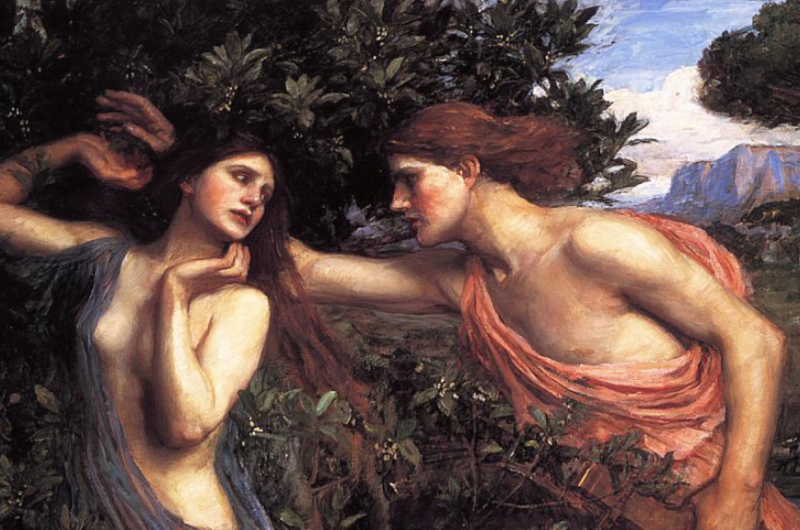
Daphne was the daughter of a river god named Peneus. She was pursued relentlessly by Apollo, who had been struck by one of Cupid’s arrows and had fallen deeply in love with her. Daphne, who had been struck by an arrow that repelled love, fled from the god until she prayed to be saved from his pursuit and was finally transformed into the first laurel tree. This transformation explains the laurel wreaths that became closely associated with Apollo and symbolize his connection to the laurel.

Io
Io was the daughter of the river god Inachus, and she became the victim of Jupiter’s desire. After Jupiter pursued Io, he transformed her into a cow to hide her from his wife, Juno. Io suffered greatly in her animal form, particularly while Juno subjected her to further torment. Eventually, Jupiter persuaded Juno to release Io, allowing her to regain her human form. Io later became associated with the Egyptian goddess Isis and gave birth to Epaphus, her son by Jupiter.
Syrinx
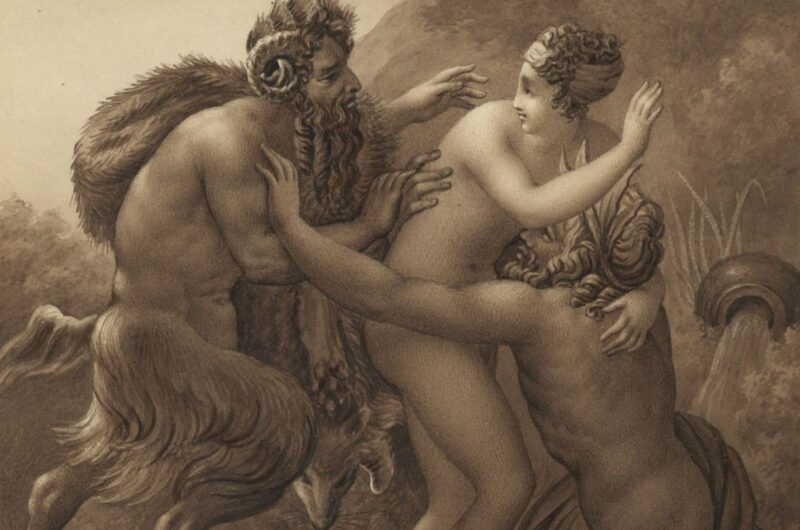
Syrinx was a Naiad who was well known for her beauty throughout Arcadia. She was pursued relentlessly by the god Pan, whom she rejected and attempted to escape. As Pan began to close the distance between them, Syrinx called upon the river nymphs for protection and was transformed into reeds, allowing her to escape his grasp. Pan, hearing the beautiful sound of the reeds in the wind, cut and joined them together to create the panpipes, which he named after Syrinx.
Notable Figures
Apollo – Apollo, who is also called Phoebus, is the son of Latona and Jupiter. He is associated with the sun, as well as medicine, music, poetry, and prophecy. He establishes the Pythian Games after vanquishing the Python that terrorized the newly restored human population. One of the most well-known symbols associated with Apollo, the laurel wreath, originates from the story in Book 1 in which he falls in love with Daphne, who is ultimately transformed into a laurel tree. Apollo, deeply in love with Daphne, cherishes the tree and declares its leaves sacred, establishing the laurel as a symbol of his power and influence.
Diana – Diana, another child of Latona and Jupiter, is the goddess of the hunt and is strongly associated with nature, chastity, and female independence. These qualities are reflected in several of the maidens who appear in Book 1. Daphne, Io, and Syrinx each have connections to Diana through their associations with nature, chastity, or their attempts to escape male pursuit. Diana therefore provides an important contrast to the gods who pursue and transform these women. As the Metamorphoses continues, Diana’s association with maidens, nature, and female autonomy becomes increasingly significant.
Conclusion
Book 1 of Metamorphoses starts with powerful creation stories, relationships, and foundations that impact later parts of the text. As the story continues in Book 2, we will follow Helios’ son, Phaethon, as he seeks out his father. Book 2 introduces more gods and notable figures, explores other well-known Roman myths, and continues to utilize frame narratives.