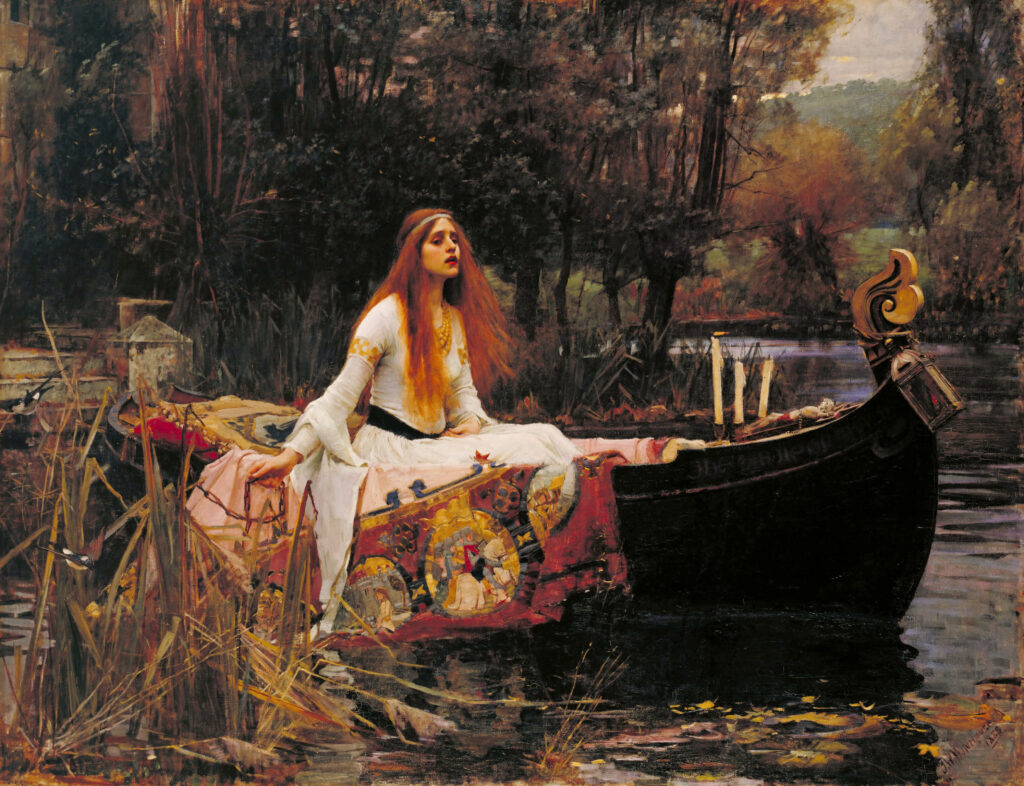
The painting above titled “The Lady of Shalott” created by John William Waterhouse in 1888 is inspired by a ballad written by Alfred Tennyson in 1833 which shares the same name. This piece is a lovely example of how the worlds of literature and art can intersect. This painting allows viewers to visually reflect upon and interpret the lady of Shalott’s experiences, her mental state, and the moments that have lead to this particular scene. With little to no knowledge of her tale, we can still sense her sorrow, heartbreak, and helplessness. If we marry a reading of Tennyson’s ballad with our interpretation of this painting we can better understand the story this piece tells and the importance of the different elements in this scene.
In this article we will briefly review Tennyson’s short story to help shed light on Waterhouse’s painting and bring a deeper interpretation to this already capitating visual story. When brought together, the ballad and the painting create a multifaceted world which we can explore in both the world of literature and the world of art.
The Lady Of Shalot by Alfred, Lord Tennyson (1833) Explained
The ballad “The Lady of Shalott” examines the experiences of a solitary weaver who is bound to a tower by a curse. Due to the nature of this curse she is forbitten to go outside or even to observe the outdoors through her window. Only through the use of a magic mirror is she is able to weave images of the world. Because her tower is not far from Camelot, there are many happenings outside of her window, and one day Sir Lancelot passes by. In the moments when Lancelot is near, she grows tired of observing the world through the mirror and is compelled to leave her weaving, her loom, and to peer out the window at Lancelot.
Once she does, however, the consequences of her curse begin to set in and the Lady of Shalott starts to die. She descends from her tower for the first time, and lays herself in a boat that will become her final resting place. The boat floats down to Camelot where Lancelot see her, he mourns the death of this unknown beauty, and the ballad is concluded.
Details of John William Waterhouse’s Painting “The Lady of Shalott” (1888)
The most important and glairing details in this piece detail the lady of Shalott’s resignation to her own death at the end of the ballad. We find her sat steadily in a boat, chain in hand to explain that she has undocked and is allowing the tide to carry her away. The blanket she is sat upon (one she may have very well weaved herself) depicts an image of a knight that could be recognized as Lancelot. In the center there is a castle and a woman who almost resembles herself.
The look upon her face is one that could produce various interpretation. If we base this expression purely on Tennyson’s ballad, then we can consider her expression to reflect a mix of dread, despair, or a melancholic relief to be freed from her solitary life. However, when considering the blanket, which could be a reflection of the lady’s desire or attraction to Lancelot, she could be entranced and off on her own dizzying, entranced search for the enchanting figure she has seen from a distance.
Final Thoughts
The Lady of Shalott, both the ballad and the painting, tells a harrowing yet beautiful story that could easily be found in a book of Grimm’s household tales. With the haunting curse shrouded in mystery and the Arthurian themes and characters, it prevails as a vibrant story to reflect upon and enjoy. This is one of many stories adapted into a painting and we will explore more areas where art and literature intersect in our next article.